

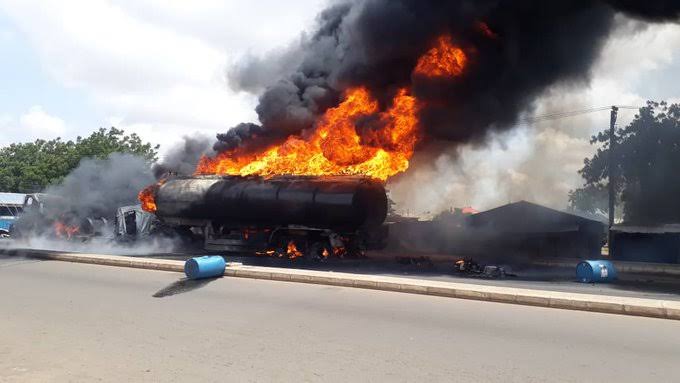
Fellow Nigerians, the tragic petrol tanker explosion at Oluku Market along the Benin–Lagos Expressway in Edo State on October 15, 2026, has once again exposed serious questions about road safety, infrastructure development, emergency preparedness, and the responsibility of government to protect human lives.
While the state was preparing to welcome Nigeria’s First Lady, Senator Oluremi Tinubu, ordinary citizens were caught in a devastating disaster that destroyed property, damaged businesses, and left several people suffering from severe burns.
According to media reports, the tanker overturned in the morning and exploded hours later. The resulting fire spread to nearby shops and vehicles. Authorities also reported injuries, while casualty figures varied across initial reports.
As an opposition journalist, I ask a fundamental question: Why must ordinary Nigerians continue to live and conduct their businesses in environments where a single road accident can turn into a major disaster?
1. POOR ROAD INFRASTRUCTURE AND THE FAILURE OF PREVENTION
Nigeria’s roads are not merely transportation routes; they are lifelines connecting communities, businesses, hospitals, and markets.
When roads are poorly maintained, when drainage systems are inadequate, and when hazardous commercial activities are allowed dangerously close to major highways, the risks to human life increase.
The Oluku tragedy demands a thorough investigation into the condition of the road, the circumstances surrounding the tanker overturning, the vehicle’s mechanical condition, and the adequacy of safety measures around the market.
A recent report by Punch quoted an expert who identified poor road conditions, vehicle defects, inadequate inspections, and poor safety compliance among the factors that can contribute to tanker accidents.
The Edo State Government and the relevant federal authorities must therefore answer important questions.
What measures were in place to identify dangerous sections of the Benin–Lagos Expressway? Were the road and its drainage infrastructure adequately maintained? Were the tanker and its safety systems properly inspected?
These questions cannot be answered through political speeches. They require independent investigation and publicly available evidence.
2. WHERE ARE THE ADEQUATE FIRE SAFETY FACILITIES?
A tanker carrying thousands of litres of petrol is a potential source of catastrophic danger when an accident occurs.
Yet the public deserves to know whether adequate emergency equipment, trained firefighters, functional fire engines, firefighting foam, and rapid-response facilities were available close enough to Oluku to respond effectively.
How quickly did emergency responders arrive? What equipment was available? Were nearby businesses adequately protected? Could the fire have been contained before it spread further?
These are legitimate questions that must be answered transparently.
The Edo State Government must not wait for another tanker to overturn before reviewing the emergency response system.
Fire stations must be properly equipped, emergency personnel must receive regular training, and high-risk locations along major highways must have clear emergency-response plans.
Public safety must be measured by the government’s ability to prevent and respond to disasters, not by the number of promises made after lives and property have been lost.
3. GOVERNMENT MUST NOT SHIFT THE ENTIRE BURDEN TO THE VICTIMS
Governor Monday Okpebholo criticised the handling of the spilled petrol, particularly the decision to transfer fuel to another tanker without adequate safety precautions. He also warned residents against scooping fuel from fallen tankers.
These warnings are important. Approaching a damaged petrol tanker to collect fuel can expose people to fire, explosions, and toxic fumes.
However, responsible leadership requires more than blaming residents after a disaster.
Authorities must establish why people were able to gather around the overturned tanker, whether the area was secured promptly, whether evacuation procedures were effective, and whether the fuel-transfer operation followed the required safety protocols.
Citizens must take personal responsibility for avoiding dangerous situations, but government agencies, tanker operators, emergency services, and regulatory authorities must also fulfil their respective duties.
A proper investigation must examine every relevant factor rather than prematurely assigning all responsibility to one group.
4. A FIRST LADY’S VISIT MUST NOT OVERSHADOW THE SUFFERING OF ORDINARY CITIZENS
The visit of Senator Oluremi Tinubu to Edo State on October 15, 2026, included the commissioning of new compressed natural gas buses and a women’s empowerment programme.
Such programmes may have public benefits, but the tragedy at Oluku raises a separate and urgent question about the everyday safety of Edo residents.
What is the value of public development if citizens cannot travel safely on major roads, traders cannot operate without fear of devastating accidents, and communities remain vulnerable to emergencies involving hazardous materials?
The issue is not whether the First Lady should visit Edo State. The issue is whether government attention to public events is matched by sustained investment in the basic infrastructure and emergency services that protect citizens every day.
Road maintenance, fire prevention, traffic management, and emergency preparedness deserve the same seriousness as high-profile public programmes.
5. THE GOVERNMENT MUST MOVE FROM CONDOLENCES TO CONCRETE ACTION
Governor Okpebholo has promised to rebuild the fire-damaged Oluku Market and support affected traders. That commitment should be followed by a clear recovery plan, transparent funding, and timely assistance to those who lost their livelihoods.
But rebuilding the market alone will not address every issue raised by this disaster.
The state and federal governments should jointly pursue the following measures:
– Independent investigation: Publish the findings on the cause of the accident, the fuel-transfer operation, and the circumstances surrounding the fire.
– Road safety improvements: Inspect dangerous sections of the Benin–Lagos Expressway and undertake necessary repairs, drainage improvements, and other safety interventions.
– Better fire protection: Strengthen fire-service capacity, provide appropriate firefighting equipment, and improve response times in high-risk areas.
– Strict tanker inspections: Enforce vehicle roadworthiness standards, including inspections of tyres, suspension, steering, tanks, and safety systems.
– Safer roadside markets: Review the safety of commercial structures and drainage channels near busy highways, while protecting traders’ livelihoods through fair and lawful measures.
– Public emergency education: Conduct sustained campaigns warning people against approaching damaged tankers or collecting spilled petroleum products.
– Support for victims: Provide transparent assistance to affected families, injured survivors, and traders whose businesses were destroyed.
These measures should be accompanied by measurable deadlines and public progress reports.
6. OUR DEMAND AS AN OPPOSITION VOICE
We in the opposition must insist that government accountability is not an act of hostility; it is a democratic responsibility.
We must ask difficult questions without spreading unverified allegations. We must demand answers without exploiting the suffering of victims. And we must hold public officials accountable regardless of political affiliation.
The people of Edo State deserve safe roads, functioning emergency services, responsible tanker operations, and a government that treats the protection of human life as a daily obligation.
The Oluku disaster must not become another headline that disappears after a few days of public outrage.
If an accident can destroy a market, burn vehicles, injure residents, and threaten lives, then the response must go beyond condolences and temporary promises. It must lead to a serious investigation, lasting reforms, and measurable improvements in public safety.
The ultimate test of governance is not simply what leaders commission during official visits. It is whether ordinary citizens can travel, trade, work, and return home safely.
The people of Edo State deserve answers. The victims deserve justice and support. And the Nigerian public deserves a government that learns from tragedy rather than waiting for another disaster to expose the same weaknesses.
Enough of preventable suffering. Enough of unanswered questions. Let accountability, road safety, and the protection of human life become priorities that cannot be postponed.Journalistic note: Before publishing, verify the final casualty figures, obtain information on the condition of the road and the availability of firefighting equipment, and seek responses from the Edo State Government, the Federal Road Safety Corps, the relevant road authority, and the state fire service. The available reports establish that a tanker overturned and exploded, but they do not independently establish that poor road conditions or inadequate fire facilities caused this particular incident. That distinction will make your commentary more credible and defensible.
Written by John Yusuf Gimba