

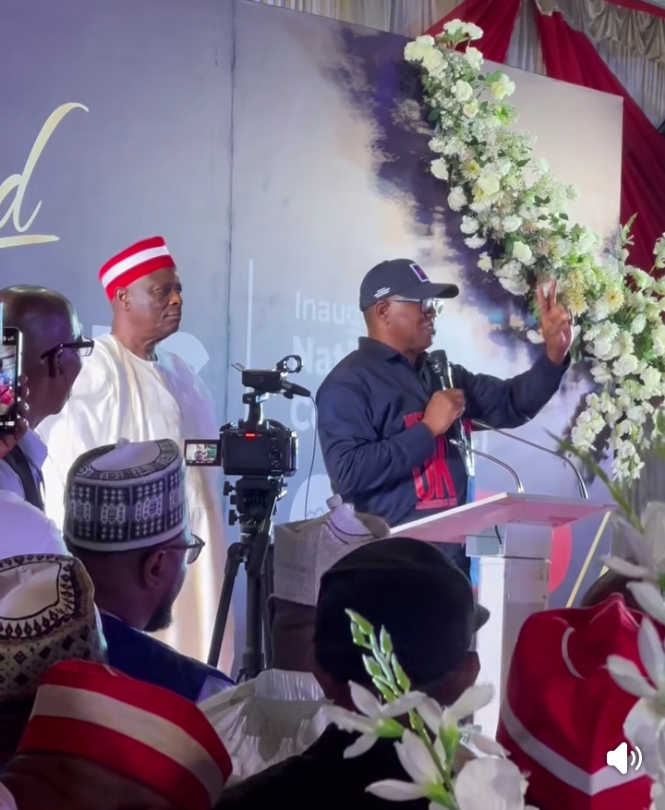
Abuja, Nigeria 26th October, 2026.
Peter Obi, the Nigeria Democratic Congress (NDC) presidential candidate, has promised a sweeping overhaul of Nigeria’s governance system, pledging to confront corruption, insecurity, hunger, unemployment and the country’s persistent electricity crisis if elected president in 2027.
In a forceful address, Obi criticised the administration of President Bola Tinubu over what he described as worsening economic hardship despite increased government revenue and borrowing. He challenged the federal government to explain how public funds had translated into improved living conditions, better infrastructure, more jobs and stronger public services for ordinary Nigerians.
The NDC candidate argued that Nigeria’s problems could no longer be addressed through political excuses, repeated promises or the continued attribution of present difficulties to previous administrations. Instead, he maintained that Nigerians deserved leadership that accepts responsibility, provides measurable solutions and demonstrates tangible improvements in the lives of citizens.
Obi’s message centred on a promise to replace what he described as a culture of blame with a results-driven system of governance in which public officials would be judged by their performance.
Obi promises an anti-corruption revolution
Declaring corruption a major obstacle to national development, Obi promised to confront the diversion of public resources and strengthen accountability across government institutions.
“We are going to bring a revolution against corruption,” he declared.
He argued that Nigeria’s development challenges could not be resolved without addressing the misuse of public funds, insisting that money belonging to the people must be deployed to meet their needs.
The former Anambra State governor questioned the relationship between government revenue, public borrowing and the economic conditions experienced by ordinary Nigerians. He challenged the administration to demonstrate how the resources available to the government had improved the welfare of citizens.
Obi’s argument was that increased revenue, where established, should produce visible public benefits, including improved schools, functioning hospitals, reliable electricity, better roads, enhanced security and greater economic opportunities.
He maintained that public officeholders must be prepared to explain how money is collected, allocated and spent.
For Obi, the fight against corruption would go beyond public declarations and require accountability for public expenditure, transparent government processes and consequences for the misuse of state resources.
His proposed approach places public finance at the centre of the debate about Nigeria’s economic recovery, with the central question being whether government spending produces meaningful results for the population.
Emergency declaration on insecurity and agriculture
Obi also pledged to declare emergencies on insecurity and agriculture, identifying both sectors as essential to addressing hunger, rural hardship and economic instability.
On insecurity, he argued that the government must demonstrate its commitment through practical action to protect lives and property, restore confidence in affected communities and enable economic activities to resume.
He stressed the importance of leadership that directly confronts national challenges rather than leaving citizens to endure persistent threats without adequate protection.
The proposed emergency on agriculture, meanwhile, reflects his emphasis on food production, rural development and the need to address the conditions preventing farmers from operating productively.
Insecurity in farming communities can disrupt cultivation, harvesting, transportation and access to markets. Obi’s position suggests that restoring security and improving agricultural productivity must be pursued together if Nigeria is to reduce food insecurity and the cost-of-living burden.
An effective agricultural emergency would require more than a declaration. It would need clear implementation targets, improved access to farm inputs and financing, rural infrastructure, storage facilities, reliable transportation and measures to protect farmers and their investments.
Obi’s broader argument is that Nigeria cannot sustainably tackle hunger without improving the conditions under which food is produced and distributed.
Electricity crisis and the burden on businesses
The NDC candidate also criticised Nigeria’s electricity situation, promising improvements that Nigerians would be able to measure rather than relying on assurances without visible results.
He argued that unreliable power supply imposes substantial costs on households, small businesses, manufacturers and other productive sectors.
For many enterprises, inadequate electricity increases operating expenses, weakens competitiveness and limits the ability to expand production or employ additional workers. Businesses are frequently forced to depend on alternative power sources, adding to the cost of goods and services.
Obi’s proposed approach places electricity reform within the wider challenge of rebuilding Nigeria’s productive economy.
He argued that government performance should be assessed through practical improvements, including the availability of electricity, the sustainability of businesses and the capacity of the economy to create jobs.
However, delivering a meaningful improvement would require a credible implementation plan covering generation, transmission, distribution, investment, regulation and the financial sustainability of the power sector.
Obi calls for the revival of industries and job creation:
Obi also highlighted the difficulties facing local industries, suppliers, contractors and young Nigerians searching for employment.
He argued that Nigeria must rebuild its productive capacity by creating conditions in which businesses can operate, expand and employ more people.
The former governor called attention to the importance of financing for businesses, particularly enterprises that struggle to access affordable credit from financial institutions.
He also stressed the need to revive industries that have shut down and strengthen domestic production rather than allow businesses to continue facing conditions that undermine their survival.
According to the thrust of his address, economic recovery must be reflected in the ability of Nigerians to find jobs, establish businesses, access finance and earn sustainable incomes.
For young people, this would mean a shift from political promises to an economic environment capable of generating employment opportunities and supporting entrepreneurship.
The challenge for any incoming administration would be to translate these commitments into specific industrial policies, affordable financing mechanisms, infrastructure investment and a stable business environment.
Questions over revenue, borrowing and public expenditure
A major feature of Obi’s address was his demand for greater accountability over government finances.
He questioned claims of increased government revenue while Nigerians continued to report economic difficulties, asking what had become of the resources generated and borrowed by the government.
His argument was that public officials should provide clear explanations of expenditure and demonstrate the outcomes achieved with public money.
The issue touches on a central question in public administration: whether higher revenue and borrowing translate into improved public services, productive investment and better living standards.
However, determining the actual relationship requires a detailed examination of federal revenue, debt obligations, capital expenditure, recurrent spending and the performance of individual government programmes.
The specific borrowing figures and poverty statistics referenced in the supplied transcript require independent verification before they can be treated as established facts.
Nevertheless, Obi’s demand for accountability places the management of public resources at the centre of his proposed alternative to the current administration.
Education and the fight against out-of-school children
Obi also reaffirmed his commitment to education, pointing to the need to reduce the number of children who are out of school and improve the quality of learning.
He argued that education must be treated as a fundamental investment in Nigeria’s future rather than merely another item in government budgets.
Addressing the out-of-school challenge would require coordinated action on school infrastructure, teacher recruitment and training, household poverty, insecurity, learning materials and the affordability of education.
In communities affected by violence and displacement, security would also be essential to ensuring that children can attend school consistently.
Obi’s emphasis on education aligns with his broader argument that government expenditure should produce outcomes that can be assessed through measurable improvements in people’s lives.
Criticism of presidential accessibility and leadership:
Obi further criticised what he characterised as inadequate direct engagement between the president and Nigerians experiencing hardship.
He argued that national leadership requires accessibility, responsibility and a willingness to confront difficult situations.
In his view, the president must remain engaged with domestic challenges, including insecurity, poverty, unemployment and the deterioration of public services.
He also suggested that Nigerians should expect their leaders to spend time understanding the difficulties confronting communities rather than relying exclusively on official explanations.
The argument forms part of his wider criticism of what he sees as a gap between government claims and the daily experiences of ordinary citizens.
“We don’t want you to hire us to tell you about our problems”
One of the central messages of Obi’s address was that Nigerians should demand solutions rather than elect leaders who merely describe existing problems.
“We don’t want you to hire us to tell you about our problems,” he said.
The statement captured his call for a performance-based approach to governance, in which elected officials would be expected to identify challenges, develop workable responses, implement policies and account for results.
Under such an approach, government performance could be assessed against measurable indicators covering electricity supply, employment, food prices, school attendance, security, public infrastructure and the effective delivery of public services.
The principle also raises an important question for the 2027 election: how will candidates convert campaign pledges into realistic, costed and measurable programmes?
For Obi, the answer lies in making public accountability central to leadership and ensuring that Nigerians can assess the results of government policies.
A promise of measurable change from day one:
Obi concluded his address by promising that his proposed administration would pursue visible improvements from the beginning of its tenure.
He insisted that Nigerians should not have to wait indefinitely for the benefits of government policies or accept explanations that fail to address their immediate difficulties.
His vision, as presented in the address, rests on confronting corruption, restoring security, improving agriculture, strengthening electricity supply, reviving industries, expanding employment and improving education.
These are ambitious commitments, and their implementation would depend on the policies adopted, available public resources, institutional capacity, cooperation between federal and state governments and the ability to establish clear priorities.
The proposals would also require measurable benchmarks, transparent reporting and independent scrutiny to determine whether promised improvements are being delivered.
As political activities ahead of the 2027 general elections gather momentum, Obi’s address adds to the debate over economic management, public accountability and the kind of leadership Nigerians expect from the next administration.
His central message was that the country’s challenges should be confronted through practical action and that public resources must produce demonstrable benefits for citizens.
For Obi, the objective is to build a country where corruption is confronted, insecurity is addressed, businesses can thrive, electricity becomes more reliable and public institutions deliver results.
**His promise is clear: Nigerians should judge leadership not by the volume of campaign promises, but by measurable improvements in their daily lives.**
*A New Nigeria is possible.*