

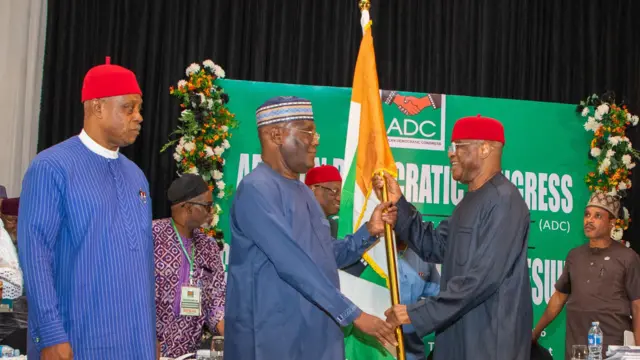
The 2027 presidential ambition of former Vice President Atiku Abubakar has suffered a major legal setback following a Federal High Court judgment in Abuja reportedly nullifying the leadership structure of the African Democratic Congress (ADC), under which he emerged as the party’s presidential candidate.
The judgment, presided over by Justice Peter Lifu, is linked to the protracted leadership crisis involving the Senator David Mark-led faction and Nafiu Bala Gombe, a former Deputy National Chairman of the party.
The dispute centres on the legality of the emergence of the David Mark-led National Working Committee and whether the processes through which the leadership assumed control of the party complied with the ADC constitution and relevant electoral laws.
The plaintiff, Nafiu Bala Gombe, had approached the court to challenge the process through which Senator David Mark and his associates assumed control of the ADC following the resignation of former National Chairman, Chief Ralph Nwosu.
Gombe maintained that, under the party’s constitution, he was entitled to assume the leadership position following Nwosu’s resignation. He argued that the emergence of the Mark-led leadership violated the ADC constitution and provisions of the Electoral Act.
In suit No. FHC/ABJ/CS/1819/2025, the plaintiff sought an order nullifying the actions of the disputed leadership and restraining Senator Mark and former Osun State Governor, Rauf Aregbesola, from parading themselves as the party’s National Chairman and National Secretary, respectively.
Justice Lifu upheld the plaintiff’s case and granted the reliefs sought, effectively invalidating the authority of the Mark-led caretaker committee and decisions taken under its leadership.
Atiku’s Presidential Ticket in Jeopardy
One of the most consequential implications of the judgment is the nullification of the presidential primary that produced Atiku Abubakar as the ADC’s flag bearer for the 2027 general election.
Atiku had already been recognised in INEC’s published list of presidential candidates and had selected former Rivers State Governor, Rotimi Amaechi, as his running mate.
The development represents a serious blow to the former Vice President, who has been positioning himself as a major opposition challenger to President Bola Tinubu in the forthcoming presidential election.
The judgment also affects other candidates nominated under the disputed ADC leadership, potentially throwing the party’s preparations for the 2027 general elections into fresh uncertainty.
ADC Vows to Challenge Judgment
However, the ADC has rejected the implications of the ruling and indicated its intention to approach the Court of Appeal.
The party’s National Welfare Secretary, Nkemakolam Ukandu, said the judgment would be challenged at the appellate court.
The planned appeal means the legal battle over the ADC leadership and its presidential ticket is far from over. The appellate court’s eventual decision will be crucial in determining the legitimacy of the party’s leadership and the future of its candidates.
A Major Test for the Opposition
The ruling comes at a critical moment when opposition parties are intensifying political mobilisation and preparations ahead of the January 16, 2027 presidential election.
For Atiku, the immediate challenge is no longer simply how to defeat his political opponents at the ballot box, but how to preserve the political platform on which he intends to contest.
For the ADC, the crisis presents a serious test of its internal democracy, leadership stability and ability to maintain its position as a viable opposition platform.
Although the judgment has invalidated Atiku’s nomination under the Mark-led leadership, it does not necessarily mark the permanent end of his presidential ambition. The pending appeal and subsequent legal developments will determine whether the ticket can be restored or whether the party will have to reconsider its political options.
Nigeria’s opposition landscape has consequently entered another period of uncertainty, with the ADC leadership crisis threatening to reshape the contest for the country’s highest political office in 2027.