

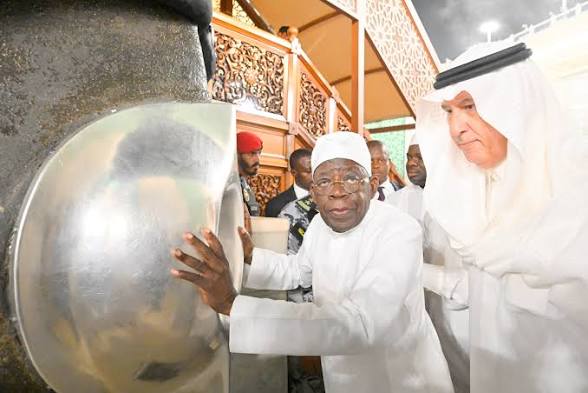
A strong criticism has been directed at President Bola Ahmed Tinubu and his political advisers over what was described as an attempt to win back Northern voters through religious symbolism rather than addressing the region’s worsening socio-economic and security challenges.
In a strongly worded address, Mr Akor Christian Oche otherwise known as Due Process mocked the alleged political calculations surrounding Tinubu’s recent visit to Kaduna to commence his campaign activities, arguing that the reception he reportedly encountered should have prompted serious reflection within the presidency about the growing dissatisfaction among sections of the Northern electorate.
According to him, after returning to the Presidential Villa from Kaduna, Tinubu ought to have convened his advisers to examine why Northern Nigerians were increasingly questioning his administration and what concrete measures could restore public confidence.
However, rather than recommending urgent interventions in security, education, healthcare, infrastructure and economic development, the speaker alleged that the president’s advisers were more interested in religious optics and political symbolism.
He claimed that the advice given to Tinubu was to undertake a pilgrimage to Mecca, secure access to the interior of the Kaaba and take photographs that could subsequently be circulated to Northern Nigerians as evidence of his religious devotion.
Due Process described the alleged strategy as an insult to the intelligence and dignity of Northern voters, insisting that religious photographs cannot substitute for effective governance.
Give Us Security, Not Photographs From Mecca’
In a particularly forceful section of his address, the speaker questioned why the administration’s political calculations did not prioritise practical solutions to the challenges confronting millions of people across Northern Nigeria.
He argued that the president’s advisers should have recommended concrete actions, including rebuilding schools, strengthening security operations, improving hospitals, constructing quality roads and ensuring that citizens could travel safely across the region without fear of attacks and abductions.
He maintained that Northern Nigerians were not looking for religious photographs or symbolic displays of piety but tangible improvements in their living conditions.
The speaker lamented that communities continue to grapple with insecurity, poverty, inadequate educational infrastructure, poor healthcare facilities and deteriorating road networks, arguing that these are the issues that should determine political support.
He particularly rejected what he portrayed as an assumption that Northern voters could be persuaded to overlook their daily hardships simply by seeing photographs of a political leader at Islam’s holiest site.
Religious Sentiments Cannot Replace Good Governance
The criticism also raises broader questions about the relationship between religion and electoral politics in Nigeria.
While religious identity and personal faith remain important aspects of public life, the speaker argued that they should not be deployed as substitutes for government accountability and measurable development.
According to him, political leaders seeking the confidence of Northern Nigerians must demonstrate commitment through improved security, economic opportunities, functional schools, accessible hospitals and infrastructure that directly improves people’s lives.
He concluded with a scathing condemnation of Tinubu and members of his political circle, accusing them of underestimating the intelligence of Northern voters and attempting to secure political loyalty through religious sentiments rather than performance.
The remarks underscore the growing debate over whether symbolic political gestures can overcome public dissatisfaction with governance as Nigeria moves towards the 2027 general elections.
The central message of the speaker was unmistakable: Northern Nigerians want security, education, healthcare, jobs and development — not photographs from Mecca presented as a substitute for good governance.