

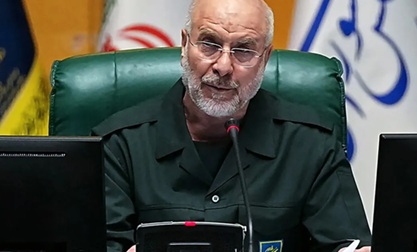
Iran’s Parliament Speaker, Mohammad Bagher Ghalibaf, has taken a fresh swipe at US President Donald Trump, using an economic equation to argue that Washington cannot solve the effects of the Iran conflict and the disruption around the Strait of Hormuz simply by raising interest rates.
Ghalibaf’s unusual intervention came after the United States Federal Reserve increased its benchmark interest rate by 25 basis points, taking its target range to between 3.75 per cent and four per cent.
The rate increase, announced on Wednesday, was the first such hike by the US central bank since 2023. The Federal Reserve said inflation remained elevated and that monetary tightening was necessary to help return inflation towards its two per cent target.
In a post on X, Ghalibaf presented a version of the Taylor Rule, an economic formula developed by economist John Taylor to help assess an appropriate level for interest rates based largely on inflation and economic activity.
But the Iranian parliament speaker turned the economic formula into a political message about the Strait of Hormuz.
“Let’s see if a hike could open SOH or produce a single barrel,” Ghalibaf wrote, referring to the Strait of Hormuz. He added, “You can’t 25bp a chokepoint,” arguing that an interest-rate increase could not resolve a disruption in a strategically important shipping route.
Ghalibaf also suggested that the risk associated with the Strait of Hormuz was influencing US monetary conditions and claimed that Iran controlled that risk.
His argument centres on the economic consequences of disruptions to energy supplies. The Strait of Hormuz is one of the world’s most important energy shipping routes, and prolonged disruption can contribute to higher oil prices. Higher energy costs can, in turn, add to inflationary pressures.
The Taylor Rule referenced by Ghalibaf is not, however, a mechanical formula that the Federal Reserve is required to follow. It is generally used as a benchmark for thinking about how interest rates might respond to inflation and economic activity. US monetary policymakers consider a much broader range of economic data when making decisions.
The timing of Ghalibaf’s post nevertheless gave his argument greater political resonance. According to Al Jazeera, the Federal Reserve’s rate decision came amid continuing economic pressures associated with the war involving the United States and Iran, including higher energy prices.
Analysts cited by Al Jazeera said the conflict has contributed to concerns about energy supplies and inflation. Susannah Streeter, chief investment strategist at Wealth Club, said the geopolitical turmoil and elevated crude prices were among the factors considered by policymakers, while also stressing that they were not the only considerations.
Other economic pressures have also been identified, including strong domestic demand and heavy investment associated with the artificial-intelligence sector. These factors can contribute to inflation independently of developments in the Middle East.
The distinction is important because Ghalibaf’s argument is essentially that monetary policy cannot directly repair a supply shock.
Raising interest rates can influence borrowing, spending and investment, thereby reducing demand in an economy. But it does not directly create additional oil supplies or reopen a blocked maritime route.
That is why Ghalibaf framed the Federal Reserve’s decision as incapable of addressing the underlying problem he says is driving energy-related inflation.
The episode is part of a broader pattern in which the Iranian parliament speaker has used economic and financial arguments in his public messaging during the conflict. Earlier in the year, he repeatedly commented on oil prices and US attempts to influence energy markets, using social media to challenge Washington’s claims and policies.
For the United States, the issue presents a difficult monetary-policy problem: an interest-rate increase can be used to respond to persistent inflation, but it cannot directly eliminate an external supply disruption.
The Federal Reserve, meanwhile, remains responsible for determining US monetary policy. Ghalibaf’s claim that Iran is effectively “setting” US interest rates therefore goes beyond what the economic evidence establishes.
As Streeter told Al Jazeera, Iran’s actions may have affected some of the forces feeding into US monetary policy, particularly through their impact on oil supplies and prices, but the final decision on interest rates remains with the Federal Reserve and depends on a wider range of economic indicators.
Ghalibaf’s equation may therefore be best understood as a political and rhetorical message built around a genuine economic problem: when inflation is being driven partly by an energy supply shock, the central bank’s conventional tools have limitations.
The exchange also highlights how the economic consequences of the Iran-US confrontation are extending beyond the battlefield, affecting energy markets, inflation expectations and monetary policy in the United States and potentially elsewhere.