

The Independent National Electoral Commission (INEC) is facing renewed scrutiny following the discovery of 453 additional polling units in its preliminary voters’ register, raising fresh questions about the accuracy, transparency and credibility of Nigeria’s electoral database ahead of the 2027 general elections.
The discovery was announced by the organisers of an ambitious independent data-gathering exercise that brought together thousands of Nigerians to examine INEC’s preliminary voters’ register, polling unit by polling unit, in an effort to identify discrepancies and possible irregularities in the electoral records.
The organisers confirmed that the nationwide data-gathering exercise had reached 100 per cent completion, marking a significant milestone in their effort to independently scrutinise the information released by the electoral commission.
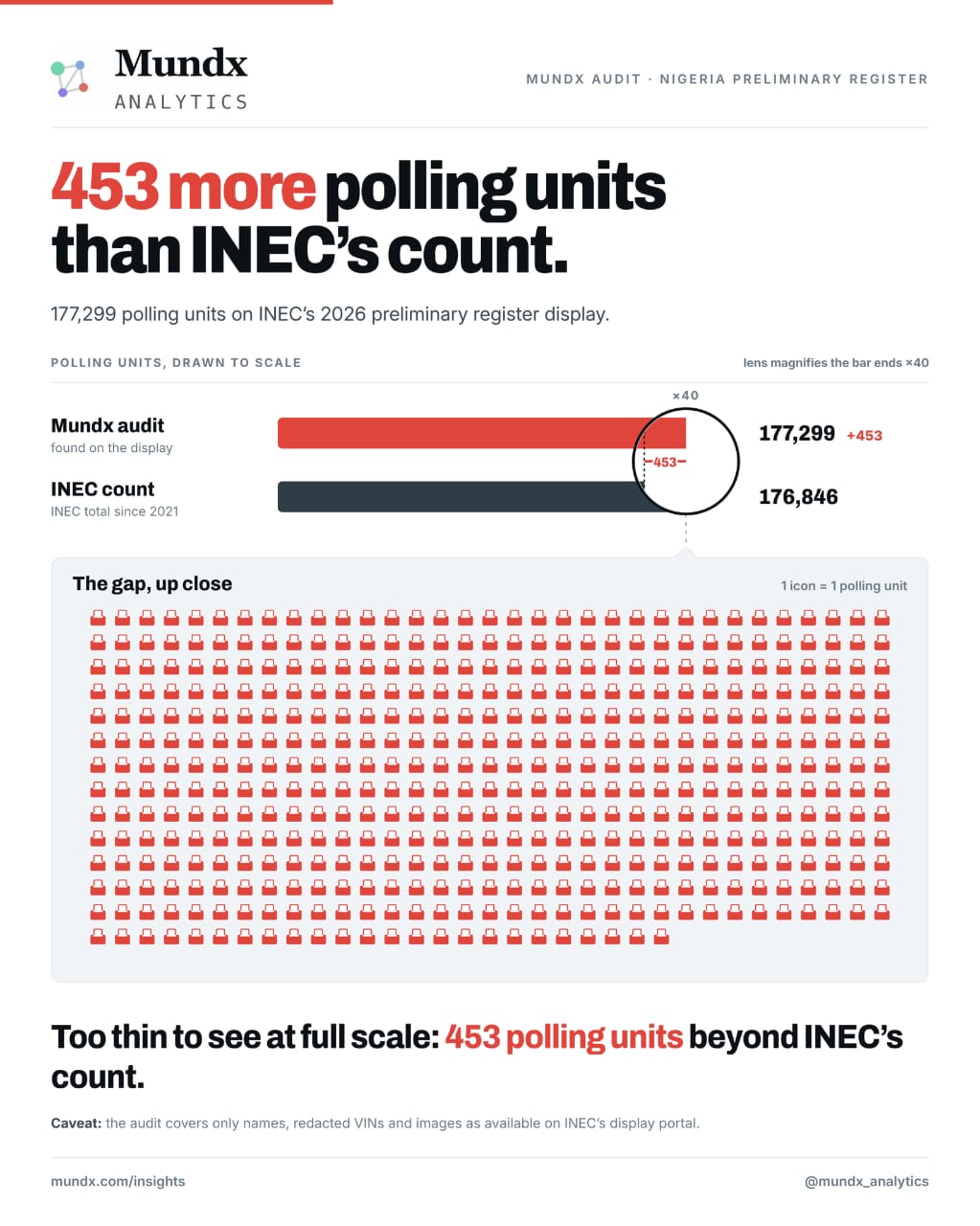
According to the first major finding from the exercise, INEC’s preliminary voters’ register display contains 177,299 polling units, instead of the established figure of 176,846 polling units.
This represents a difference of 453 polling units, a development that has triggered concerns about the origin, classification and documentation of the additional units appearing in the commission’s preliminary database.
The discrepancy raises several important questions that INEC must urgently address. Were the additional 453 polling units newly created? If so, when were they approved, where are they located, and what administrative or legal procedures guided their creation?
Alternatively, could the difference have resulted from duplication, data-entry errors, inconsistencies in the commission’s records or the inclusion of polling locations that were not previously reflected in the official figures?
These questions are particularly important because polling unit figures are fundamental to the organisation and administration of credible elections. They determine the geographical distribution of voters, allocation of electoral materials, deployment of polling officials and the overall management of election-day activities.
The implications for the 2027 elections
The discovery comes at a particularly sensitive period when Nigerians are demanding greater transparency from INEC over the credibility of the electoral process.
The integrity of the voters’ register is one of the foundations of a credible election. Any unexplained discrepancies in the underlying database could create uncertainty about the accuracy of voter distribution and the commission’s preparedness for the next general elections.
If additional polling units have legitimately been created, INEC has a responsibility to publish their locations, identification numbers, approval records and corresponding voter statistics so that political parties, civil society organisations and independent observers can verify them.
If, however, the discrepancy is caused by duplication or administrative errors, the commission must identify and correct such inconsistencies before the final register is adopted.
More importantly, the exercise demonstrates the importance of independent citizen participation in protecting Nigeria’s electoral integrity. Thousands of Nigerians voluntarily examining electoral data across polling units represents an important form of public oversight.
Rather than dismissing such findings, INEC should welcome independent scrutiny and provide verifiable explanations.
INEC must come clean
The commission cannot afford to leave critical questions surrounding its electoral database unanswered, particularly amid growing public concerns about alleged irregularities in the preliminary voters’ register, including reported AI-generated photographs, questionable voter records and other data inconsistencies.
The latest finding should therefore serve as an opportunity for INEC to open its records to independent verification and demonstrate that every polling unit appearing in its database is genuine, properly documented and traceable.
Nigerians deserve an electoral register that can withstand public scrutiny, not one surrounded by unexplained figures and unanswered questions.
As the organisers prepare to present further findings from their completed data-gathering exercise, attention will undoubtedly turn to INEC’s response and the commission’s willingness to reconcile the reported discrepancies.
The credibility of the 2027 elections must begin with the credibility of the voters’ register.