

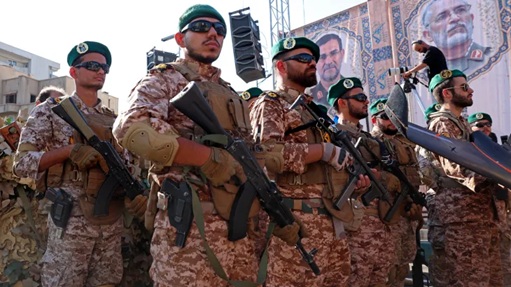
Iran has warned that any fresh military attack by the United States would trigger a sustained and “painful” response against American positions and interests across the Middle East, raising fears of another escalation in the region.
The warning was issued on Sunday by Iran’s Khatam al-Anbiya Central Headquarters, the country’s joint military command, amid reports that Tehran had received information suggesting Washington was preparing to resume military action against Iran.
Iranian military authorities said any new American attack would be met with retaliation against US bases and interests in the region “without any limitations or considerations.”
The statement also warned countries in the region against supporting or facilitating any US military action against Iran, saying governments that participate would be regarded by Tehran as parties to the conflict.
Iran did not provide independent evidence for its claim that a new US attack was being prepared. Reuters reported that the Iranian military did not elaborate on the intelligence it said it had received concerning a possible new offensive.
The warning comes as tensions between Washington and Tehran have risen sharply following renewed hostilities and military exchanges across the Middle East.
US President Donald Trump said on Sunday that he had entered what he described as a critical decision-making phase regarding Iran, warning that “very big things” could happen in the near future if Tehran did not change its conduct.
Trump also indicated that he could be open to meeting Iranian President Masoud Pezeshkian during the United Nations General Assembly week in New York.
The conflicting signals — military threats on one hand and possible diplomatic engagement on the other — have added uncertainty over the direction of the conflict.
Iranian officials have also communicated conditions for returning to negotiations with Washington through Qatari mediators. Iran’s top security official, Mohsen Rezaei, told Al Jazeera that Tehran had conveyed its demands for ending the war and resuming talks.
Among the issues raised by Tehran are an end to the conflict and measures concerning Iranian assets and the naval blockade. The diplomatic channel through Qatar has remained one of the few avenues for communication between the two sides.
The latest confrontation has also raised concerns beyond Iran and the United States because of the strategic importance of the Persian Gulf and the Strait of Hormuz, a major route for global energy shipments.
Recent fighting has already affected shipping and energy markets, while military activity involving US forces, Iran and regional actors has increased the risks of a wider confrontation.
The United States has also issued a security alert warning Americans in the region about the possibility of unforeseen escalation, including potential flight disruptions and airspace closures.
Meanwhile, Iran’s warning comes after a series of attacks and counterattacks involving US forces and Iranian targets. Earlier this month, the United States said it had destroyed five Iranian oil tankers after accusing Iran’s Islamic Revolutionary Guard Corps of attempting to target an American warship. Iran subsequently claimed attacks against several ships and US-linked military positions.
The situation remains fluid as world leaders prepare to gather in New York for the United Nations General Assembly. Diplomatic efforts are expected to feature prominently alongside discussions over the wider Middle East conflict.
For now, Tehran’s latest warning signals that any renewed American military operation could lead to retaliation extending beyond Iran itself, while Washington’s latest statements leave open both military and diplomatic options.