

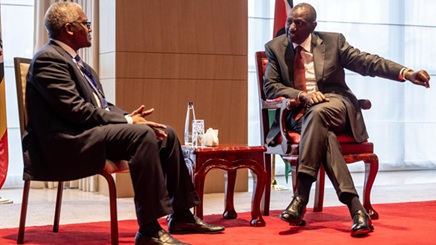
Kenyan President William Ruto has announced that the country is ready to break ground on the proposed East Africa Refinery in Lamu, a multibillion-dollar project being developed with Nigerian industrialist Aliko Dangote.
Ruto made the announcement on Monday after meeting with Dangote, President and Chief Executive Officer of Dangote Industries, and Samaila Zubairu, Chief Executive Officer of the Africa Finance Corporation, on the sidelines of the 81st United Nations General Assembly in New York.
The discussions focused on financing arrangements and final preparations for the commencement of the refinery project, which Kenya has identified as a major investment in its energy and industrialisation plans.
“We are ready to break ground on the East Africa refinery in Lamu,” Ruto said, describing the project as one that would enhance regional energy security, increase local value addition, create jobs and support industrialisation.
The proposed refinery is estimated to cost about Sh2.2tn, equivalent to approximately $17bn, and is designed to process up to 700,000 barrels of crude oil per day. The facility is expected to serve Kenya and other markets across East and Central Africa.
The groundbreaking has been scheduled for September 30, 2026. Kenyan authorities expect the wider development to generate more than 60,000 jobs and support the establishment of an energy, petrochemical and industrial hub around Lamu.
The location is strategically important because Lamu is home to a deep-water port and forms part of the Lamu Port-South Sudan-Ethiopia Transport, LAPSSET, corridor. The refinery is therefore expected to be integrated with transportation, storage, logistics and other industrial activities around the port.
Kenyan officials have said the project could help reduce the country’s dependence on imported refined petroleum products while strengthening its position as a regional energy and logistics centre. Kenya spent about Sh511.5bn on petroleum products in the previous year, according to The Star.
For Dangote, the Lamu project would represent another major refinery investment after the company’s large-scale refinery in Lagos, Nigeria. The Nigerian facility has a reported capacity of about 650,000 barrels per day and began operations in 2024.
However, the Kenyan project still faces questions around financing, crude-oil supply and supporting infrastructure. Kenya currently lacks commercial-scale crude production sufficient to meet the requirements of a 700,000-barrel-per-day refinery, meaning regional crude supplies would be important to the project’s long-term operation.
The Kenyan government has positioned the investment within a broader strategy to attract private capital into major infrastructure and industrial projects. Ruto has also been promoting greater mobilisation of African savings and investment capital for development projects across the continent during his engagements in New York.
With the September 30 groundbreaking date approaching, attention is now turning to the final financing arrangements and implementation framework for what Kenya expects to become one of its largest private-sector investments and a major component of its regional energy strategy.