

Abuja, Nigeria. 28th October 2026.
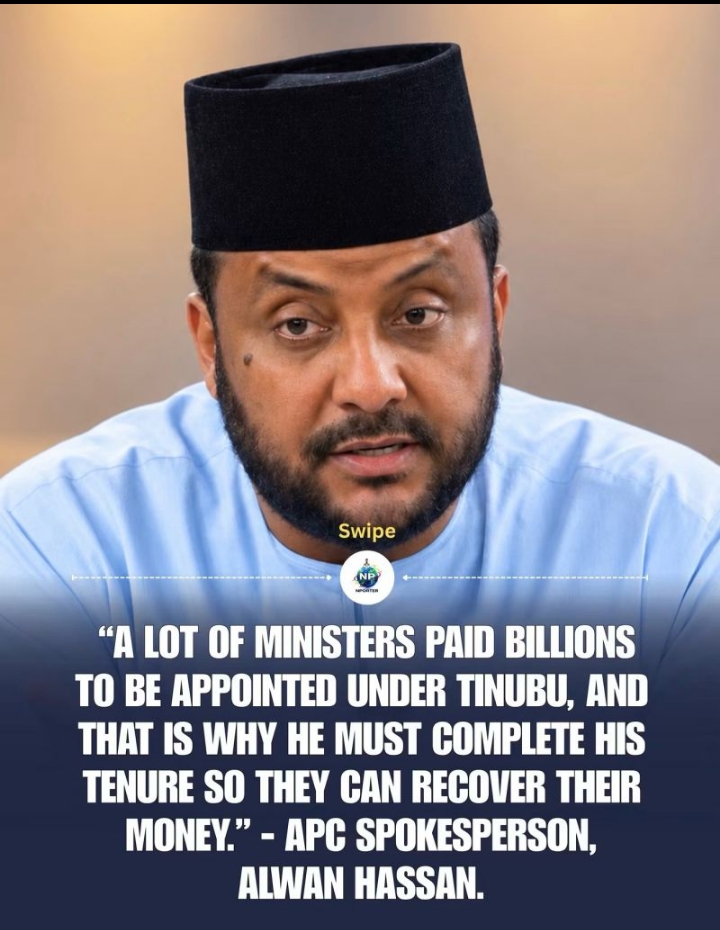
Claim that some ministers allegedly paid billions to secure appointments and want Tinubu to complete his second term to recover their money sparks debate over political patronage, public accountability and the purpose of public office.
An allegation attributed to All Progressives Congress (APC) spokesperson Alwan Hassan, suggesting that some ministers paid billions of naira to secure appointments under President Bola Tinubu and are eager for him to complete his second term to recover their money, has raised serious questions about political patronage and accountability in Nigeria’s public service.
The reported statement has drawn attention to the potential implications of treating political appointments as financial investments, particularly in a country where millions of citizens expect government officials to prioritise public welfare, economic recovery, security and national development.
If accurately reported and supported by evidence, the allegation would raise fundamental questions about the circumstances surrounding ministerial appointments and whether any improper financial arrangements influenced access to public office.
However, the allegation has not been independently verified for this report. The identities of the ministers allegedly involved, the amounts purportedly paid, the recipients of any such payments and the circumstances surrounding the claim remain unestablished.
A serious allegation with far-reaching implications
The suggestion that individuals may have paid billions of naira to secure ministerial positions is a serious claim that requires more than political commentary. It calls for evidence, clarification and, where appropriate, an investigation by the relevant authorities.
Ministers occupy positions of significant public responsibility. They oversee government departments, participate in policy decisions and help determine how public resources are allocated and administered.
Their appointments should be guided by the constitutional process, competence, integrity and the capacity to deliver measurable benefits to Nigerians.
If financial inducements were used to secure such positions, the implications would extend beyond the individuals allegedly involved. It would raise questions about the transparency of the appointment process, the potential for conflicts of interest and whether private financial considerations could influence decisions made in the public interest.
The allegation therefore deserves careful scrutiny, without assuming that it has already been proven.
Why the alleged motive for a second term matters
The most consequential aspect of the reported claim is the suggestion that some ministers want President Tinubu to complete his second term so they can recover money allegedly spent securing their appointments.
If that interpretation accurately reflects Hassan’s remarks, it raises questions about the motivations attributed to those ministers and the relationship between political power and private financial interests.
A second presidential term should ordinarily be evaluated through the administration’s record, policy outcomes, constitutional responsibilities and the interests of the Nigerian people.
The suggestion that some officeholders might support the continuation of an administration to recoup alleged personal investments introduces a different consideration—one that warrants examination if evidence supports it.
Nevertheless, support for a president’s second term does not itself demonstrate an improper motive, and the reported statement does not establish that any particular minister has acted unlawfully.
The critical issue is whether there is verifiable evidence of payments connected to ministerial appointments and whether such payments, if established, involved wrongdoing.
Questions for the presidency and the APC
The allegation places the spotlight on the need for clarity from both Hassan and the presidency.
First, did Hassan make the statement as reported, and what evidence informed his remarks? Given the seriousness of the allegation, an authenticated recording, transcript or direct clarification would help establish precisely what was said and the context in which it was made.
Second, were any payments made in connection with ministerial appointments? If so, who allegedly made the payments, who received them, and what was the stated purpose?
Third, if evidence of improper payments emerges, what steps will the relevant authorities take to establish responsibility and ensure accountability?
These questions should be addressed through evidence rather than speculation. Neither political affiliation nor official position should shield anyone from a credible investigation, just as no individual should be condemned on the basis of an unverified allegation.
Nigerians bear the consequences of poor governance
The controversy also touches on a broader concern about the relationship between political leadership and the everyday realities of ordinary Nigerians.
Citizens expect ministers to focus on economic opportunities, employment, education, healthcare, infrastructure, insecurity and the effective management of public resources.
Where allegations emerge suggesting that financial considerations may have influenced access to public office, public confidence can be affected unless the facts are established transparently.
The public deserves assurance that ministerial appointments are made through legitimate procedures and that those entrusted with national responsibilities are accountable for their conduct.
If the allegation is unfounded, a clear explanation would help prevent misinformation from spreading. If credible evidence supports it, the appropriate authorities should investigate and take action in accordance with the law.
A matter of public interest
The reported remarks attributed to Hassan have created an opportunity for an important public-interest discussion: what standards of transparency and accountability should govern access to positions of authority?
The answer should not depend on which political party is in power. The same standards must apply to every administration, every minister and every public official.
President Tinubu’s government has a responsibility to ensure that the integrity of public appointments is not undermined by allegations of financial inducements. Hassan, if accurately quoted, also has a responsibility to clarify the basis of his claim.
Ultimately, the credibility of the allegation will depend on the evidence available, not the political controversy it generates.
The central question remains whether any ministers paid money to secure appointments and whether there is credible evidence that they expect to recover those alleged investments through their positions in government.