

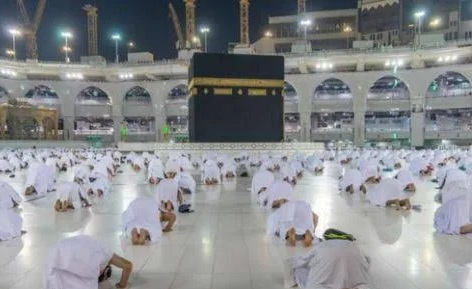
The Kingdom of Saudi Arabia has rejected Nigeria’s request for an increase in its allocation for the 2027 Hajj, leaving the country with an approved quota of 50,000 pilgrims despite growing demand from intending pilgrims and appeals from state pilgrims’ welfare boards.
The National Hajj Commission of Nigeria, NAHCON, disclosed the development in a statement, saying it had formally approached the Saudi Ministry of Hajj and Umrah to seek additional slots for Nigerian pilgrims.
According to the commission, Saudi authorities declined the request because of capacity limitations, structural constraints at the holy sites and the Kingdom’s policy of maintaining approved country quotas under the existing operational framework.
NAHCON Chairman and Chief Executive Officer, Ambassador Ismail Abba Yusuf, acknowledged that the decision could disappoint intending pilgrims and state pilgrims’ welfare boards that had expected an increase in Nigeria’s allocation.
Yusuf said the commission had explored available diplomatic and operational channels to secure additional slots but would respect the final decision of the Saudi authorities.
“We appreciate the deep spiritual desire of many Nigerian Muslims to perform Hajj and understand the expectations of states and stakeholders seeking additional slots,” he said.
He added that the Saudi authorities had communicated their final position based on operational realities and capacity considerations.
Under the approved arrangement, Nigeria will retain 50,000 slots for the 2027 pilgrimage. Of this number, 35,000 places are allocated to government pilgrims, while 15,000 are reserved for pilgrims travelling through licensed private tour operators.
The commission urged state pilgrims’ welfare boards, agencies and licensed tour operators to ensure that the available allocations are used judiciously and transparently.
NAHCON also reminded stakeholders that the deadline for uploading the details and biometric information of prospective 2027 pilgrims remains September 26, 2026. The commission warned that the deadline would not be extended.
Yusuf urged all state pilgrim boards, tour operators and other representatives involved in the exercise to ensure that the required information is submitted before the deadline.
For intending pilgrims who are unable to secure a place for the 2027 pilgrimage because of the limited quota, NAHCON said registration for the 2028 Hajj had already commenced.
The commission said the 2028 registration portal is open and encouraged affected prospective pilgrims to consider registering for the subsequent pilgrimage.
NAHCON further said states are expected to complete payment of their 2027 Hajj fares by December 2, 2026, in line with the operational requirements for the pilgrimage.
The commission said compliance with the quota approved by Saudi Arabia is a global requirement applicable to countries participating in the annual pilgrimage and is necessary for the orderly management of Hajj operations.
The development comes amid wider discussions over the allocation of Nigeria’s 2027 Hajj slots. On Sunday, NAHCON also rejected allegations that 5,000 Hajj slots had been diverted, describing the claims as unfounded and maintaining that the 50,000 approved places had been allocated in accordance with applicable Nigerian and Saudi regulations.
According to the commission, the 15,000 slots reserved for private operators were distributed among licensed operators operating under seven approved lead companies.
NAHCON has urged prospective pilgrims using private operators to ensure that their registration and biometric details are successfully uploaded to the designated Saudi platform before the September 26 deadline.
Despite Saudi Arabia’s refusal to increase Nigeria’s allocation, the commission said preparations for the 2027 Hajj were continuing as planned.
It also reaffirmed its commitment to transparency, fairness and the welfare of Nigerian pilgrims, while promising to provide further updates on operational guidelines and the implementation of the new business-to-business framework through its official communication channels.