

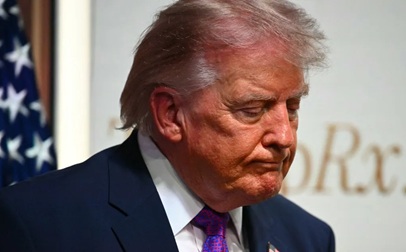
US President Donald Trump has said Washington may be approaching the end of its war with Iran, claiming that he has spoken directly with Iranian officials as diplomatic efforts to end the conflict appear to be gaining renewed attention.
Trump made the comments on Wednesday while speaking to reporters, saying, “Hopefully we are toward the end of the war,” and adding that Iran “want[s] to make a deal.” He also said he had heard from the Iranian side “directly”, although he did not provide details about who he spoke with or when the communication took place.
The claim comes amid renewed diplomatic activity surrounding the seven-month conflict, but there has been no public confirmation from Tehran that direct negotiations with Washington have resumed.
A senior Iranian official, Mohsen Rezaei, secretary of Iran’s Supreme National Security Council, said a day earlier that Tehran would not enter talks unless its conditions were met. He accused Trump of sending “mixed signals” and maintained that Iran’s position remained tied to the terms it has demanded for any diplomatic settlement.
The disagreement highlights the uncertainty surrounding Trump’s claim of direct communication. Previous efforts to establish negotiations between Washington and Tehran have frequently relied on intermediaries, including Oman, Qatar and Pakistan.
Former Iranian diplomat Abbas Khameyar also questioned the significance of Trump’s statement, telling Al Jazeera that he was not aware of any major diplomatic development beyond efforts already under way in recent weeks. He said Tehran’s focus remained on securing implementation of an existing memorandum of understanding rather than immediately opening an entirely new negotiating process.
Diplomatic activity increases
Despite the lack of confirmation of direct US-Iran negotiations, diplomatic contacts in the region have intensified.
Iranian Foreign Minister Abbas Araghchi held a telephone conversation with Pakistan’s army chief, Field Marshal Asim Munir, on Thursday. According to Iran’s semi-official Tasnim news agency, the discussion focused on regional developments and issues of mutual interest.
Munir has been involved in mediation efforts between Washington and Tehran, making Pakistan an important channel in attempts to prevent the conflict from escalating further.
China has also increased its diplomatic engagement. Chinese Foreign Minister Wang Yi recently called on the United States and Iran to exercise restraint and reopen the Strait of Hormuz, a strategically important waterway that has been severely disrupted during the conflict.
Following his meeting with Chinese officials, Araghchi said Tehran wanted the restoration of calm and peaceful relations with neighbouring countries. He also described consultations in Beijing as successful.
China’s President Xi Jinping has previously indicated that Beijing is willing to play a role in efforts to restore peace in the Middle East.
Strait of Hormuz remains central
The Strait of Hormuz remains one of the biggest obstacles to resolving the crisis.
The waterway carries a significant share of global oil and gas shipments, and its disruption has pushed energy prices higher. Oil prices crossed $100 a barrel last week, increasing pressure on governments and businesses around the world.
The economic consequences have also become an important factor in US domestic politics, particularly as higher energy prices affect American consumers. Reuters reported that the rise in oil and gas prices linked to the conflict has become a major issue for Trump’s Republican Party ahead of the November midterm elections.
A previous US-Iran memorandum of understanding was intended to create a 60-day period for peace negotiations and included provisions concerning the reopening of the Strait of Hormuz. However, the agreement expired after Washington and Tehran accused each other of violating its terms.
Yemen adds another complication
The diplomatic situation has also become more complicated because of renewed fighting in Yemen.
Iran-aligned Houthi forces have expanded their military activity and have been involved in clashes with Saudi Arabia. Reuters reported that the Houthis launched attacks against Saudi targets, while the fighting has increased concerns about the security of regional shipping routes.
At the same time, US officials reportedly met Houthi representatives in Oman over the weekend. According to sources cited by Reuters, the meeting was facilitated by Oman and focused on preventing attacks on American and commercial vessels.
The development is notable because the Houthis have been a major factor in the wider regional security crisis, particularly around the Red Sea and Bab al-Mandeb maritime corridor.
For now, Trump’s statement signals a possible opening for renewed diplomacy, but the available evidence does not yet establish that formal direct negotiations between Washington and Tehran have resumed.
With Iran maintaining demands concerning the existing agreement, the United States seeking an end to the war and regional powers such as Pakistan, Oman and China attempting to facilitate dialogue, the next stage may depend on whether the two sides can bridge their differences over the Strait of Hormuz and the broader terms of a settlement.