
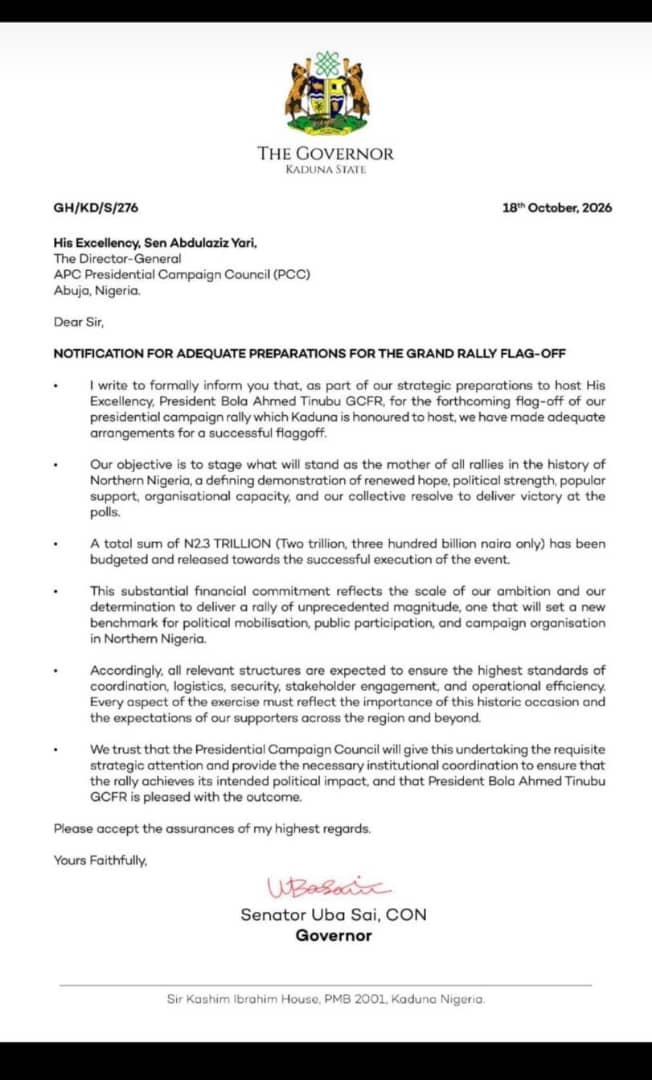
The controversy surrounding a viral letter claiming that the Kaduna State Government budgeted and released ₦2.3 trillion for the APC presidential campaign flag-off in Kaduna has sparked questions about public expenditure, political campaign financing and the priorities of government.
The letter, purportedly signed by Governor Uba Sani and dated 18 October 2026, claimed that the amount had been approved for the rally. However, the Kaduna State Government publicly disowned the document on 24 October, describing it as fabricated and insisting that no such expenditure had been authorised. The APC Presidential Campaign Council also rejected the allegation. The ₦2.3 trillion figure must therefore not be presented as an established campaign expenditure.
Nevertheless, the controversy provides an opportunity to examine the scale of Nigeria’s public spending priorities and the importance of transparency in political financing.
Dangote Refinery: An Industrial Investment Worth Billions
Nigeria’s industrial development received a major boost with the construction of the Dangote Refinery, an integrated petroleum refinery and petrochemical complex with an initial capacity of 650,000 barrels per day.
The project attracted an investment estimated at approximately $20 billion. At an illustrative exchange rate of ₦1,500 to the dollar, that translates to about ₦30 trillion.
By comparison, the disputed ₦2.3 trillion rally figure would represent approximately $1.53 billion at the same exchange rate—about 7.7 per cent of the refinery’s estimated construction cost.
The comparison highlights the enormous sums involved, but it must be understood correctly: the refinery investment is a real industrial project, while the alleged rally expenditure has been officially denied.
How Does ₦2.3 Trillion Compare With Nigeria’s Health and Education Budgets?
The Federal Government’s 2026 budget speech outlined approximately ₦3.52 trillion for education and ₦2.48 trillion for health. These are sector-level allocations, which should not be confused with the narrower budgets of individual ministries.
If the disputed ₦2.3 trillion figure were accurate, the comparison would be extraordinary.
Education: ₦3.52 trillion was allocated to the education sector. The alleged rally expenditure would amount to approximately 65 per cent of that allocation.
Health: ₦2.48 trillion was allocated to the health sector. The alleged rally expenditure would amount to approximately 93 per cent of that allocation—nearly the entire annual health-sector budget.
These comparisons are illustrative, not evidence that money was diverted from either sector. No verified evidence presented in the controversy establishes that public funds were spent on the rally or taken from health or education.
The Questions Nigerians Deserve to Ask
Nigeria continues to face substantial challenges in healthcare delivery, educational infrastructure, unemployment, poverty and insecurity. Public spending should therefore be examined not only in terms of its size but also its source, authorisation, purpose and measurable benefits.
How much do political campaigns actually cost? Who finances them? Are campaign expenditures transparently declared? And what safeguards ensure that public money appropriated for public services is not diverted to partisan activities?
These questions remain legitimate irrespective of the controversy surrounding the viral letter.
The Kaduna State Government says the document is fraudulent. That denial must be reflected accurately in responsible reporting. At the same time, the episode demonstrates why authentic budget records, independently verifiable documents and transparent campaign-finance disclosures are essential in a democracy.
The bottom line: Nigeria’s education and health budgets deserve scrutiny, and political campaign financing deserves transparency. But accountability must be built on verified facts, not an allegation that the authorities have publicly disowned.
Source references: Federal Government of Nigeria, 2026 Budget Speech; TheCable, 24 October 2026; Leadership, October 2026.